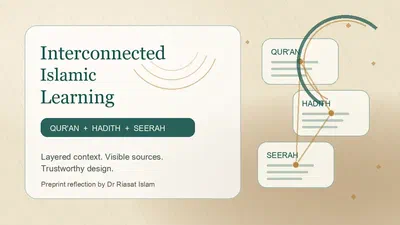
What I Shared at Cambridge Muslim College About Islamic Computing
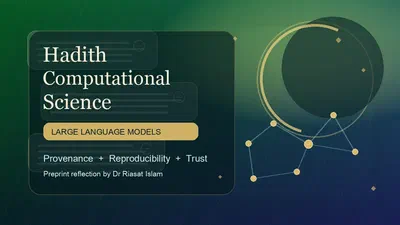
A reflection on my Cambridge Muslim College talk on Islamic Computing, Greentech, and how Muslims can build technology, research, and institutions that genuinely benefit people.
Since around November 2025, the pace of AI development has been absolutely relentless.
Retrieval-Augmented Generation (RAG) systems are evolving quickly. A few months ago the conversation was dominated by Model Context Protocols (MCPs). But after recent announcements from Perplexity AI and others, it seems AI tooling is moving closer to CLIs and APIs, integrating directly into developer workflows rather than relying heavily on new middleware layers.
Last weekend I built, shipped, and pushed a reasonably complex piece of software to production.
Several thousand lines of code. Live. Working.
Time spent: a weekend.
This would have been unthinkable not long ago.
There are now several thousand Islamic apps in the market, with hundreds more launching every month. At the same time, many Muslim-majority countries are experiencing rapid demographic and technological growth, particularly among young people who are highly active on mobile devices.
A practical, evidence-based look at how AI can support marking and feedback in higher education without compromising fairness or academic standards.
Summary:
This article gathers the most common questions students, particularly from South Asia, ask about pursuing a PhD in AI and NLP. It explains how to assess academic readiness, choose suitable supervisors and universities, identify meaningful research gaps, and explore impactful directions, including ethical AI and Islamic knowledge technologies. The Q&A is fully anonymised and based on recurring themes from many student conversations, offering practical guidance while ensuring privacy.
Summary:
This article continues the Q and A series on higher studies, focusing on common questions from students in South Asia. It covers choosing between a Master’s and a PhD, funding challenges, selecting countries, balancing marriage and higher studies with Islamic considerations, managing academic direction, and understanding what scholarship committees look for. All scenarios are generalised to protect student privacy and provide practical guidance for anyone considering studying abroad.
A reflection on how Islam transcends language barriers — from varsity days to global digital da’wah through GTAF.
A reflection on a small donation from Mayotte that reminds us how the Prophet’s ﷺ timeless prophecy continues to unfold in our digital age.
A reflection on how travel reshapes our perspectives — inspired by a simple culture shock during my first trip to Germany.
A true story of patience, faith, and perseverance — how Zaynab’s journey through hardship reminds us that with every difficulty comes ease.
A growing archive of Friday sermons (khutbahs) I’ve delivered over time — reflections on faith, character, and the Prophetic example.
In 2026, your audience is everywhere — from TikTok to Telegram to ChatGPT. Here’s why tracking referral sources might be your smartest growth insight.
Short, sensible guidance from the Russell Group. Two gaps I’d add: environmental impact and misuse/dual-use risks.
One of the simplest yet most powerful acts of worship a believer can perform is sending ṣalawāt (salutations and blessings) upon the Prophet Muḥammad ﷺ. This short phrase, often said as Allāhumma ṣalli ʿalā Muḥammad, carries immense spiritual reward and connects us directly to Allah and His Messenger ﷺ.
When we hear the word zakah, our minds usually go to zakah of maal (wealth) or zakah al-fitr. But there is another form that is not often talked about — the zakah of knowledge (zakah al-‘ilm).
Recently, I came across a thought-provoking piece by Prof. Rajgopal: The PhD is the New MBA. He highlighted that some of the core skills developed during a PhD are exactly the ones we need when engaging with today’s large language model (LLM) technologies:
One of the most powerful refrains I’ve picked up throughout my research and innovation journey is this:
Our goal: fall in love with the problem, not the idea.
✨ Reflections on Reading the Qur’an ✨
One of the habits that stuck with me from my teacher is to always use a full Mushaf when reading, reciting, or memorising the Qur’an. Our brains are remarkable at picking up visual cues — the structure of the page, the placement of ayahs — and over time, this builds a “snapshot memory” of the Qur’an.
Naming and normalising the painful phase of growth so teams can push through it together.
Exploring the importance of connections and networking when seeking jobs or hiring candidates.
An exploration of communication techniques from the Quran, Hadith, and Seerah, emphasizing the importance of truthfulness, kindness, humility, and active listening.
Exploring how Islamic principles align with and enhance the problem-solving approach of design thinking.
Exploring first principles thinking through the lens of Islamic teachings, highlighting examples from the Quran, Hadith, and Seerah.
Exploring systems thinking from an Islamic lens, highlighting examples from the Quran, Hadith, and Seerah that encourage believers to view the world and life in an interconnected, holistic way.
Reflections on hiring, building a team, and the importance of values alignment at GTAF.